
EN
The Shelf My Wife Wanted Gone

My wife Renata gets an idea in her head and there's no talking her out of it. I learned that in the first year we were married, and I relearned it eleven years later when I cleaned out our garage in Rockford, Illinois, and found one leftover shelf leaning against the wall like it was waiting for a verdict.
I wanted to haul it to the curb. Trash day was Wednesday. I'd already loaded the truck bed with busted lawn chairs and a dehumidifier that stopped working around the Bush administration, and this shelf was next.
"Don't," Renata said from the doorway, coffee mug in hand, still in her scrubs from the overnight shift at the hospital. "I want to build something with that."
"Build what?"
"I don't know yet."
That's how it always starts with her. Not a plan. A feeling.
Two days later she showed me a photo on her phone — some cabinet outside a church over on the east side, hand-painted, stuffed with canned goods. TAKE WHAT YOU NEED, LEAVE WHAT YOU CAN. She'd been driving home from her shift and pulled over to look at it like it was a museum piece.
"I want one," she said. "For us. By the mailbox."
I'll be honest — my first thought wasn't generosity. My first thought was: property value. We live on a corner lot on a street where everybody mows on Saturday and nobody puts anything in their yard that isn't a flag or a flamingo. I pictured raccoons. I pictured somebody's teenager filling it with beer cans as a joke. I pictured the HOA letter that was sure to come, even though we don't technically have an HOA, which somehow made it worse — like I'd have to invent the argument with myself.
I didn't say any of that. I said, "Okay. I'll build the box, you figure out the paint."
That Saturday we built it in about four hours, out of scrap plywood and a roof shingle sample I had left over from redoing the back porch. She painted it white, put a strip of pale blue along the roofline, and lettered the front herself — her hand's steadier than mine, always has been, comes from years of starting IVs. NEIGHBORHOOD PANTRY. EVERYONE WELCOME. I dug the post hole. She stocked the shelves with black beans, a box of Cheerios, a jar of Jif, two liters of water.
For two days, nothing. I caught myself checking it more than she did, honestly — walking the dog an extra loop past the mailbox, glancing over like it might do something.
Third day, the cereal was gone. Fourth day, somebody swapped the pasta for two cans of green beans, which struck me as a strange trade until I understood — they weren't shopping, they were also giving.
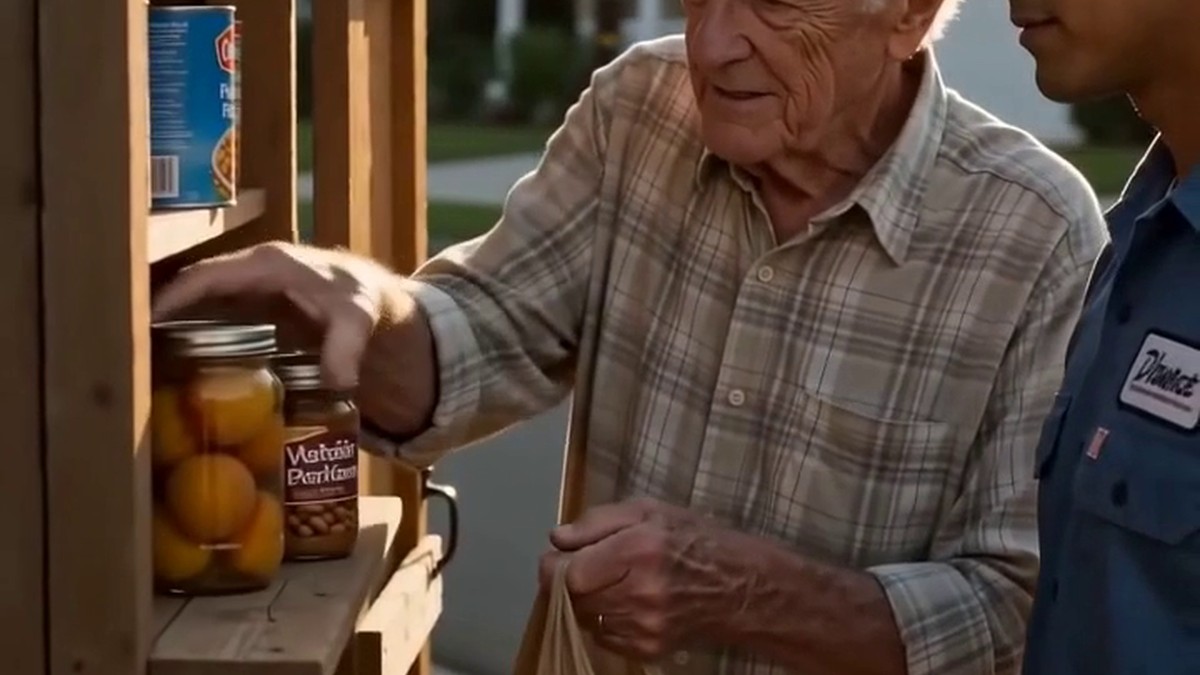
Here's the part that got me, though, the part Renata never really talks about because she wasn't the one standing there: the retired guy from two doors down, Walt Furman, showed up one Saturday morning with a grocery bag while I was out front resetting a sprinkler head. Canned peaches, kidney beans, a jar of peanut butter.
"My wife used to say sharing food is another way of saying you care," he told me, setting the bag on the step. Walt's wife had passed the winter before. I hadn't known what to say to him at the funeral, and I still didn't know what to say to him on my own driveway, so I just said, "That's a good way to put it." He nodded and kept walking his route past three more houses.
That's when it stopped being Renata's project to me. It became mine too, quietly, the way things do when you're the one restocking it at six in the morning before work because you noticed the shelf was empty and it bothered you more than you expected.
By October there was a basket of knitted hats nobody asked for. By Thanksgiving, neighbors were dropping off stuffing mix and pie crusts faster than we could arrange them, and somebody left a stack of recipe cards rubber-banded together. I found a note tucked behind the cranberry sauce the night before the holiday: *We're celebrating together this year because of this pantry.* I didn't show Renata right away. I stood in the driveway and read it twice, then put it on the fridge myself before she even saw it.
The trouble started in January, when the pantry had been running about four months and had, by then, become something the whole block pointed to when new people moved in — "that's the free pantry, everybody uses it." My brother-in-law Curtis, Renata's older sister's husband, came by for the game one Sunday and stood at the window with a beer, watching a woman he didn't recognize take a can of soup off our shelf.
"You know people are gonna start dumping their garbage food out there," he said. "Expired stuff. Then it's your name people associate with it when somebody gets sick."
"Nobody's gotten sick, Curtis."
"Not yet."
He wasn't wrong to worry, exactly — it's a fair thing to wonder about — but there was something underneath it that had nothing to do with expired soup. Curtis had lost his job at the plant that fall and hadn't told anybody outside the family for weeks. Renata found out from her sister and didn't say a word to him about it, just started leaving an extra bag of groceries "for the pantry" on our porch that somehow always ended up, a few days later, at his back door instead. He never asked where it came from. I don't think he wanted to know. And I think that's exactly why he stood at our window running down a project his wife's sister ran, instead of saying the thing that was actually eating at him.
It came to a head in February. Curtis and Renata's sister came for dinner, and somewhere between the pot roast and the dishes he brought it up again, louder this time, half a beer past where he usually stops. Said the pantry made the neighborhood "look poor." Said people were going to think we couldn't afford our own house if we were out there handing out canned peaches to strangers.
Renata didn't raise her voice. She got up, went to the fridge, and pulled off the thank-you note that had been sitting under a magnet since Thanksgiving — the one about celebrating together, the one nobody ever signed — and set it on the table in front of him.
"Read that," she said. "Then tell me again what it looks like."
Curtis read it. He didn't say anything for a long minute. Then he pushed his chair back, walked out to his truck, and came back in carrying two bags of canned goods he'd apparently bought on the way over and never mentioned — like he'd meant to leave them anonymously on the step and lost his nerve.
"For the box," he said, not looking at either of us, and set them by the door.
Nobody made a thing of it. Renata just said, "Thank you, Curtis," and went back to the dishes.
He still grumbles about the pantry sometimes, out of habit more than conviction. But he's the one who fixed the hinge on the little door last spring when it started sagging, spent an hour out there with my drill while I held the flashlight, and neither of us said much of anything the whole time.
The shelf's been gone from the garage for over a year now. Last week I counted — we've gone through it four times, ground to roof, restocking it ourselves, and lost count of how many times somebody beat us to it. A woman two streets over leaves fresh bread on Fridays before her shift starts. Somebody keeps the granola bars stocked without fail. Renata still doesn't know who left the flowers by the post last month. Neither do I.
I used to think I married someone with too many ideas and not enough patience for consequences. Now I think the consequence was the point — she just never bothered explaining that part, she let the shelf do it.




One Dollar for Thunder
I trained that dog for four years before I understood what he actually was. Not a tool. Not a piece...


The $43 Sensor I Taped Above My Mother’s Bedroom Door
I found my grandmother Dorothy on her kitchen floor at eleven in the morning, back in 2009. She'd missed her...


The Van I Bought for Sofia After I Almost Swiped Left
I almost didn't message her. That's the part nobody knows. Her profile picture was a close-up, cropped tight, so you...


The Empty Chair at Miller’s Diner
My name's Ray Kowalski, I'm forty-six, and I own a body shop off Route 9 outside Scranton. For eleven years,...


Table Six and Mason Hartley’s Paper Bag
Jefferson Elementary smelled like floor wax and tater tots that Tuesday in October, the kind of smell that gets stuck...


Reba Stopped Eating, So I Asked My Sister for the $2,400
I'm Casey Mercer. I'm thirty-four, I work three days a week as a vet tech at Muskingum Valley Animal Hospital,...


Walt Hobbs Sold 47 Ewes So His Son Could Read
People in Ten Sleep still ask me how my boy turned into the kind of man who flies into Casper...


Eppure era proprio quello che mi succedeva ogni volta che mio suocero veniva a trovarci.
Non avrei mai immaginato di arrivare a quarantasette anni e provare vergogna per una cosa così semplice: essere felice quando...