
EN
Harold’s Cat Refused to Leave the Bed

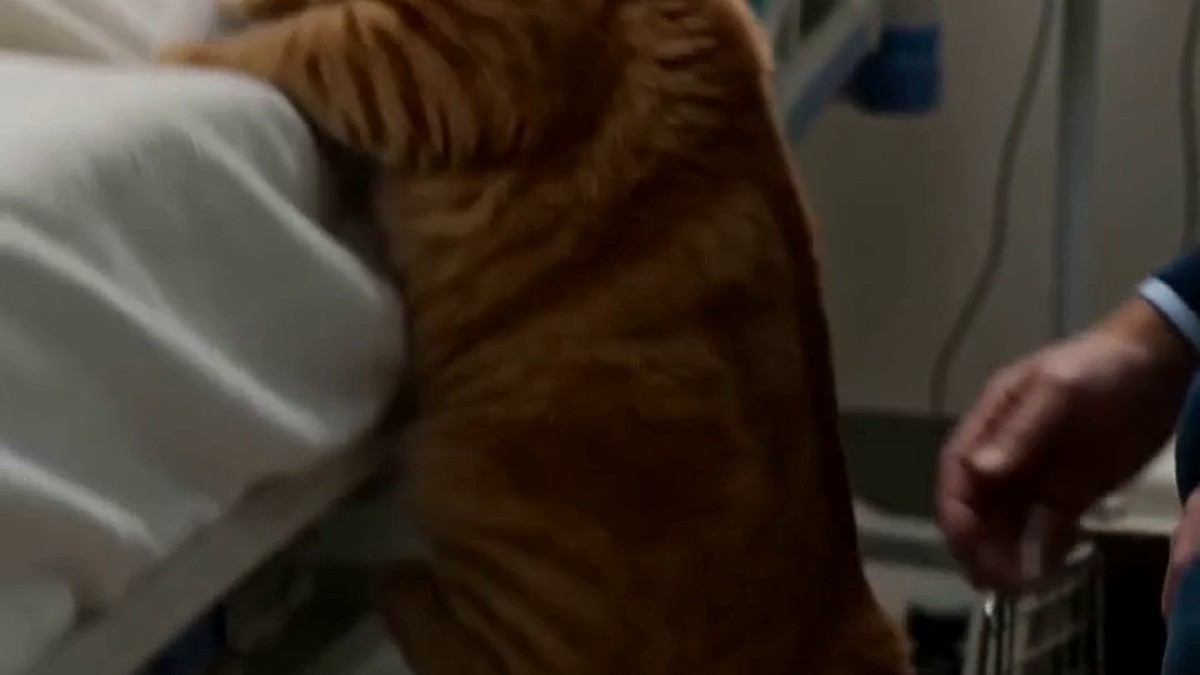
The fluorescent light over the hospital bed in Portland buzzed like a dying fly. Harold’s son, Mark, sat in a plastic chair that made his back ache, watching the tubes and wires do their quiet work. His father hadn’t opened his eyes in two days.
“He keeps asking,” the night nurse had told Mark at shift change. “Not for water. Not for pain meds. For the cat.”
The cat was sixteen years old. A fat, half-blind orange tabby named Biscuit who had moved in with Harold after Harold’s wife, Doreen, passed. The cat had spent the last seven years sitting on Harold’s lap during the evening news, following him to the bathroom, sleeping on the pillow beside his head. When the ambulance came, the cat had yowled so loud the neighbors called the police.
Mark drove back to his father’s house that morning with the heat on full blast, even though it was May. The house on 82nd Avenue smelled like menthol rub and old newspapers. Biscuit was curled on the afghan at the foot of the bed, and he raised his head when Mark came in, his cloudy eyes tracking the sound.
“Come on, boy,” Mark said. He’d never much liked the cat. It was his mother’s cat first, and after she died, it became his father’s. Mark was the one who got the phone calls, the ones where his father talked to the cat more than he talked to him.
The carrier was in the hall closet, still covered in ten years of dust. Biscuit fought him at first, then went still, like he understood the stakes. The whole drive to the hospital, the cat pressed his face against the mesh and made a sound Mark didn’t have a word for.
At the nurses’ station, a woman in scrubs with a rainbow lanyard held up her hand. “Sir, we don’t typically allow pets in the ICU.”
“He’s dying,” Mark said. He said it flat, the way you’d say the bus is running late. “His chart says comfort care. The cat’s his comfort.”
The nurse, whose badge read J. RAMIREZ, looked at the carrier, then at Mark’s face, then at the carrier again. She handed him a visitor sticker. It said GUEST. Mark pressed it to the carrier and kept walking.
The room was small and beige and too bright. Harold lay with his mouth open, skin the color of candle wax, a line of dried spit at the corner of his lips. His hands were swollen, the fingers curled like claws against the sheet. The oxygen machine hissed. A monitor over the bed drew green mountains on a black screen.
Mark set the carrier on the chair and unlatched the door. Biscuit stepped out, low and slow, his tail twitching once. Then the cat went stiff. He lifted his nose and tasted the air — that hospital smell of antiseptic and dying — and for a second Mark thought the whole thing was a mistake.
Then Biscuit jumped onto the bed.
It was an old-man jump, graceless and heavy, and the bed shifted under Harold’s weight. The cat moved up the blanket with the care of an animal who knows the ground is not to be trusted. And then, with a gentleness that made Mark’s throat close up, Biscuit pressed his whole soft body against Harold’s cheek.
“Dad,” Mark said. His voice came out cracked. “Dad. Biscuit’s here.”
Harold’s eyes didn’t open. But his hand — the one Mark had been holding for two days, hoping for a twitch, a sign, anything — his hand moved. It rose an inch off the blanket, trembling with the effort of a man lifting a house, and came down on the cat’s back.
The cat began to purr.
It was a deep, broken little motor, a sound from someplace ancient. Biscuit pushed his face into the hollow of Harold’s neck and purred and purred, and the green mountains on the monitor kept their rhythm, and Mark sat down in the plastic chair and put his head in his hands.
“Dad,” he said again. “I’m sorry I never came around that much.”
He said it to his father, but he said it to the cat too.
Biscuit didn’t leave the bed for the next seven hours. The staff changed shifts. A janitor came in and emptied the trash, and a woman from the kitchen brought a tray of food Mark didn’t touch, and all the while the cat stayed pressed against the old man’s face, bathing the closed eyelids with his rough tongue, once, twice, a third time.
At 4:18 in the morning, the room was so still that Mark could hear the elevator chime down the hall. He had not slept. His phone sat dead in his jacket pocket. Somewhere outside, a siren dopplered away toward the river. Then the monitor changed tempo. The green mountains grew jagged. Slowed.
Harold’s chest rose. Held for too long. Fell.
And did not rise again.
Mark was on his feet before he knew it, reaching for the call button, but his hand stopped halfway there. Because the cat stood up. Biscuit stood over his father’s face, his tail wrapped around his paws, and he opened his mouth. What came out wasn’t a yowl. It was a single, soft meow, so full of knowing that Mark had to turn away and stare at the wall until his breathing evened out.
The death had been expected. That’s what the doctor said later. What the nurse said. Mark filled out paperwork in a waiting room with a television playing a cooking show. He signed forms with a pen that was running out of ink. He drove back to the hospital at noon, when the basement office opened, to talk about arrangements. When he was done, he walked out to the parking garage and stood by his truck with the keys in his hand for a long time.
That’s when his phone rang. It was the hospital.
“Mr. Alden?” The voice belonged to J. RAMIREZ, the nurse. She sounded like she’d been crying.
“What’s wrong?”
“It’s the cat. He won’t move.”
They’d left Biscuit in the room too long. When they came to prepare the body, the cat was still on the bed, still pressed against Harold’s neck. When they tried to pick him up, he bit a male orderly on the thumb. Not hard, the man said later. But he wouldn’t go in the carrier. He wouldn’t leave the body.
Mark took the elevator up. Fluorescent light, the smell of floor wax and burnt coffee from the cart by the nurses’ station. Ramirez met him at the door to the room and put her hand on his arm, her fingers light on his sleeve.
“I’ve seen a lot,” she said. “I’ve seen dogs wait by the front door for months after the funeral. But this one… it’s like he knows the exact second your father went. He’s been lying there since. He won’t eat. He won’t drink.”
Mark pushed the door open. The room had that blank quality rooms get after someone dies: the bed made, the machines off, the window curtains half-open onto a cream-colored afternoon. The cat was a small damp shape on the floor beside the bed, not on it now, but on the linoleum, his chin on his paws, his tail wrapped tight. The food the staff had left — a paper bowl of wet cat food from a corner store, some kibble — sat untouched. The water had a dead fly floating in it.
Biscuit lifted his head an inch. His cloudy eyes found Mark, and the expression in them was not pleading. It was resignation. The cat had done what cats do. He had sat through the night, through the death, through the departure of his person. And now, clearly, he was choosing the same road.
Mark didn’t try to reason with the cat. He didn’t make soothing noises or offer a treat. He walked across the room, scooped Biscuit into his arms the way you’d lift a child from a river, and carried him out of the room, down the corridor, past the nurses’ station, out to the parking garage, and into the passenger seat of the truck. Biscuit didn’t fight. But he kept looking back toward the hospital entrance as it disappeared in the rearview.
At home, Mark shut himself in the bathroom and ran the shower so the neighbors wouldn’t hear him. When he came out, the cat was sitting in the exact middle of the kitchen floor, staring at the empty armchair. He stayed there for the rest of the day.
The cat didn’t eat for three days. Mark drove him to a vet on Sandy Boulevard who felt his belly and checked his gums and said there was nothing physically wrong. “He’s grieving,” said the vet, a tired woman with a clip in her gray hair. “They do that. Sometimes they stop.”
“He was my dad’s,” Mark said. “I was never much for pets.” The vet was writing something on a pad. “Then maybe you should pass him along,” she said. “He’d be better off with someone who can love him the way your father did.”
Mark drove home in the dusk with a bag of special liver treats on the passenger seat and the cat in the carrier on the floor. The house was silent. On the kitchen counter, the phone was blinking with a message from the funeral home. Mark played it once and then erased it.
He set Biscuit down on the linoleum. The cat sniffed the air and turned in a slow circle. Mark took a can of tuna from the pantry — the good kind, packed in olive oil, the kind his father kept for sandwiches he hardly ate — and opened it with a can opener that hung on a nail by the stove. He drained the oil into a bowl and set it down.
“Come on,” Mark said. His voice was rough, not with grief but with something older — shame, maybe. “Dad would want you to eat.”
Biscuit looked at him across the kitchen. For a long moment, neither of them moved. Somewhere down the street a dog barked twice and a porch light clicked off.
Then the cat put his head down and began to lap at the oil, and Mark pulled out a chair and sat with his elbows on the yellow Formica table and watched him.
He didn’t get rid of the cat. He didn’t call the shelter or the rescue or post a listing on Nextdoor. He moved the armchair so it faced the window, and every evening he sat in it with Biscuit on his lap, and the two of them watched the light leak out of the sky over the Hollywood district, and Mark talked. Not to himself. Not to his father. To the cat.
He told him about the time his mother made him ride the carnival coaster alone because she was too scared, and about the girl in college he should have married, and about the year he gave up on calling his father because every conversation turned into an argument. He told Biscuit things he had never said to a living soul — not to his ex-wife, not to his own daughter, who lived in Spokane and called only on birthdays.
And at night the cat slept on the pillow beside his head.
Six weeks later, in late June, Mark went back to the hospital. This time he parked in the same garage, walked the same corridor, stood at the same nurses’ station. J. RAMIREZ was there, typing at a computer. She recognized him and took off her glasses.
He set a manila envelope on the desk. Inside were his father’s discharge papers — the ones he’d never gotten around to filing — and a handwritten note. The note was short. It said: *For the room where my father spent his last hours. Use this to let more families bring their pets. It won’t cure anything, but it will make the leaving easier. It did for him.*
He had also written the check. Not a big amount — four hundred dollars, all he could spare from the account his father left, which was mostly eaten by the funeral home. Four hundred dollars, designated to a pet-friendly room fund.
Ramirez looked at the check, then at Mark. Her eyes went glassy, but she nodded and closed the envelope over the check. “I’ll make sure it gets where it needs to go.”
Mark turned to leave. At the door, he stopped.
“The cat,” he said. “He still looks for him, sometimes. But he’s eating. He’s out of the carrier.” He paused. “I sat in my father’s chair last night, and he jumped up, and I thought — I finally understood what the old man was holding onto all those years. It wasn’t just a cat.”
He didn’t say the rest, because the rest was a thing he couldn’t get his voice around.
He walked out into the parking garage, where the air was cool and smelled of concrete and wet leaves, and got into the truck. On the passenger seat was a yellow plastic bag from Fred Meyer. Inside was a new lint roller, a box of dental treats, and a small rainbow toy mouse with a bell in it.
He started the engine and pointed the truck toward home. On the radio, a man was talking about the weather. It would rain again. It always did, this time of year.
Mark turned the radio off and drove in the quiet, one hand on the wheel, the other resting on the bag, and he thought about the heft of four hundred dollars, and the way the nurse had looked at him, and the precise weight of a cat choosing, again, to stay.




The Mechanic’s Second Act
I never set out to be the villain in my mother-in-law's story. But apparently that's what I am now —...


The Second Spring of Carol Hatfield
Carol Hatfield turned sixty-three on a Tuesday in March, standing in the kitchen of her house on Linden Avenue in...


Winnie Doesn’t Wait by the Fence Anymore
For forty-six days, Winnie stayed at the back of her kennel, on a gray blanket that smelled more like bleach...


Forse quel piccione torna al nido perché è l’ultimo luogo in cui tutto gli sembra ancora familiare.
Forse quel piccione torna al nido perché è l’ultimo luogo in cui tutto gli sembra ancora familiare. Lì ha trascorso...


The Hoodie That Broke the Cameras on Fulton Street
Maya Okonkwo noticed the blinking amber light above the pharmacy door on a Tuesday in late September, the kind of...


La promessa più importante che facciamo a un cane non viene pronunciata ad alta voce.
La promessa più importante che facciamo a un cane non viene pronunciata ad alta voce. Non la scriviamo su un...


The Seven Containers in My Garage Freezer
My name is Linda, I'm 68, and I live in a two-bedroom bungalow in Dayton, Ohio, the same house where...


The Only Dance That Mattered
My name doesn't matter much here. What matters is that I was seventeen, standing in the gym of Westbrook High...