
EN
The 21st Floor Delivery That Rescued a Nine-Figure Deal

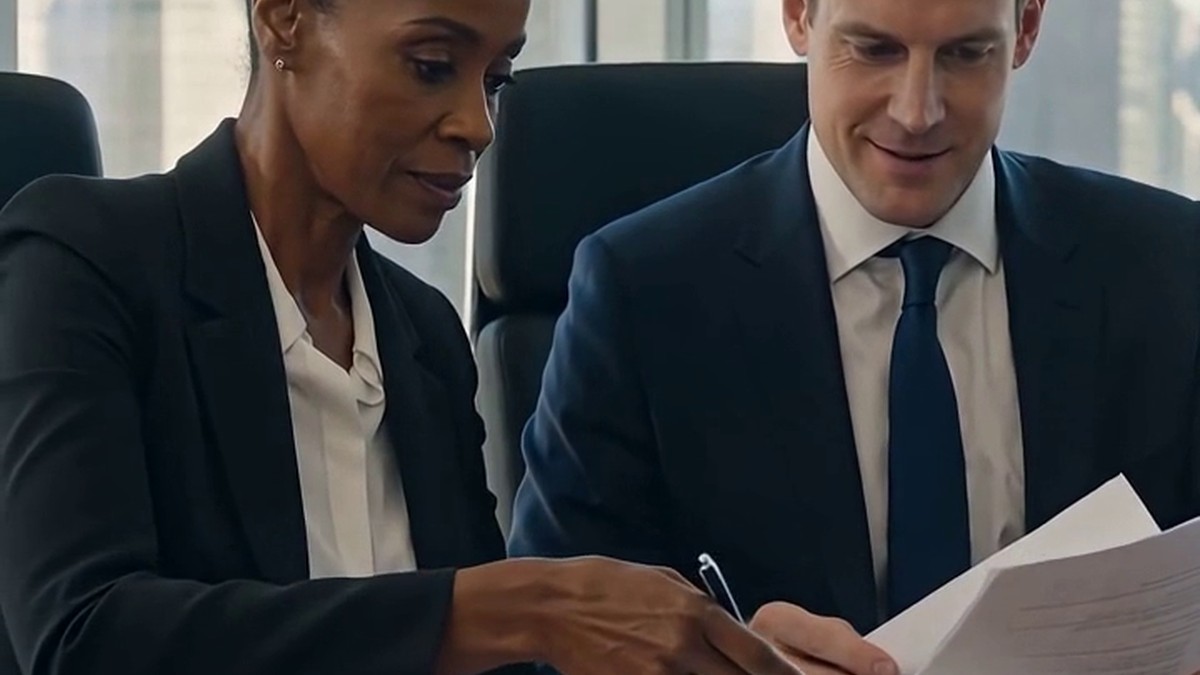
They thought I was just the girl with the coffee.
Amber Reyes set the two cardboard trays on the credenza by the door and checked her phone. Eight minutes past the delivery window. The app was already counting the penalty, twenty-five cents a minute, and the sandwiches for the law firm on Seventeen were going cold in her thermal bag. Her rain jacket dripped onto the carpet tiles, and she could feel the wet patch spreading across her left shoulder blade.
Nobody looked at her. That was normal. At the conference table, six people were staring at a monitor like it had insulted their mothers. Amber raised her phone for the signature, waiting for someone to notice her, and while she waited, she read the screen.
Two columns. Mandarin on the left, English on the right. A contract.
The man at the head of the table had his arms folded. Gray suit, maroon tie, the kind of loose skin around the eyes that comes from fifteen years of sleeping on airplanes. He wasn't reading. He was waiting. Next to him, a younger man in a blazer that looked like it still had the tags on was talking with his hands.
"I know you're smart," the younger man said. He had turned in his chair and was looking at Amber with a grin that didn't reach his eyes. "Translate for us."
Two guys at the end of the table snorted. Amber stood there with the rain soaking through her sneakers.
She'd worked nine months as a courier. She'd learned not to look at the screens, not to read the documents, not to hear the phone calls. You deliver. You get the signature. You leave. That's the whole job.
But she was already reading.
The English paragraph said the Seattle company obtained an exclusive license to the battery technology for five years, with the right to transfer it to subsidiaries without additional consent. The Mandarin paragraph said something else. She translated it twice in her head, sure she was missing something, but the characters didn't move. Non-exclusive. Three years. No mention of subsidiaries.
"Miss." The gray-suited man finally spoke. "If you're waiting for a tip, this isn't the moment."
"Your contract doesn't match itself," Amber said.
The room went quiet. Not the fake kind, where people pause before laughing. The real kind. Paper stopped rustling. The woman from legal, who'd been flipping pages with mechanical precision, set her pen down.
The younger man stood up. "This is a confidential meeting. You need to leave."
Amber looked at him. "The Mandarin version gives you a three-year non-exclusive license. The English version gives you five years, exclusive, with the right to assign to subsidiaries. Those aren't translation differences. Somebody rewrote it."
The Chinese delegation's lead negotiator, a man in his sixties with round glasses and a face like a closed door, said something quiet to his lawyer. The lawyer responded. The old man's eyes moved to Amber.
He asked her a question. In Mandarin.
Amber answered.
He asked another. Longer this time. She answered again, and she could feel the words coming back, the grammar, the tones, the thing that had been her whole life before the money ran out.
The gray-suited man was staring at her now. "What is he saying?"
"He's asking why the English side added a provision about subsidiaries. He says that wasn't in the draft they approved in Shanghai."
"I didn't add anything," the gray man said, but his voice had changed. It wasn't the voice of a man who was sure. It was the voice of a man who was doing a very fast calculation.
"She brought coffee," the younger man said. "She's not part of this meeting. We need to clear the room."
Amber didn't move.
"Fine," she said. "Clear the room. But first, download both versions of that file. Right now. Before the break. Because after a break, one of them might not be there anymore."
The gray-suited man looked at the younger man. Then at the woman from legal. Then at the screen, where the two columns sat side by side, saying different things.
"Get IT on the phone," he said quietly. "Now."
The younger man opened his mouth. The gray man held up one hand, and the younger man closed it again. The woman from legal was already dialing.
It took eleven minutes. The file had been uploaded that morning from the finance director's credentials. The finance director, as everyone in the room pretended not to notice, was the younger man in the blazer with the tags.
His name was Derek. Amber learned that because the gray-suited man — Victor Callahan, it turned out, founder and CEO of Meridian Battery Systems — said it loudly, twice, in a tone that made the woman from legal wince.
The Chinese delegation closed their folders. The old man with the glasses spoke to his lawyer, who spoke to Callahan's assistant, and the whole meeting was moved to four o'clock the next day.
Amber held out her phone again. "I have to go. I've got another delivery."
Callahan signed. His signature was a slash of dark ink, the kind of movement a man makes when he's used to signing things.
"What's your name?"
"Amber Reyes."
"Where did you learn Mandarin?"
"University of Washington. Three years of the Asian Studies program."
"Three years. Why didn't you finish?"
She didn't answer right away. The question had a shape she recognized, the shape of a door she'd closed a long time ago, and she didn't feel like opening it for a stranger in a gray suit. But something about his face had shifted. He wasn't waiting anymore. He was actually looking at her.
"I had to work," she said.
Callahan asked for her number. She gave it to him, picked up her thermal bag, and walked out. In the elevator, she checked her phone. The penalty had stopped counting. A missed call from her mom. She called back as the doors opened onto the lobby, and her mom's voice was thin and tired but okay, she was okay, the doctor had adjusted the prescription, yes, she'd taken it with food.
That night, Amber sat on the floor of her studio apartment in Renton, sorting coins, and thought about the four hundred and twelve dollars in her checking account. She did not think about the contract. She did not think about Derek's face when Callahan had said his name. She did not think about it.
The next morning, Callahan called and offered her a job in the contracts department. Three months, with an option to extend. Salary was four times what she made as a courier. The office was in Pioneer Square, twenty minutes from the Swedish Medical Center campus where her mom had her appointments.
Amber asked for the offer in writing. They sent it over that afternoon. It was thirteen pages, and she read all thirteen of them twice, marking lines with a pencil. One clause said the employer could expand her duties without additional compensation. She crossed it out with a single clean stroke and wrote the correction in the margin.
When the HR manager saw it, she laughed. Not in a mean way. Just surprised.
"Nobody reads these that closely," she said.
"This one tried to give me a five-year exclusive license," Amber said.
Three weeks into the job, Amber found the discrepancy. It wasn't in her contract. It was in a vendor agreement that the finance department had rushed through while everyone else was on a deadline. A payment schedule that shifted a million-eight in penalties onto Meridian if the vendor missed a single delivery window. The vendor's name, in tiny type at the bottom of the attachment, was a shell company.
Specifically, a shell company whose registered agent was Derek's sister-in-law.
Amber sat at her desk and stared at the screen for a long time. Then she printed the document, put it in a folder, and walked it down the hall to Callahan's office.
She didn't say anything about Derek. She didn't need to. She put the folder on the desk, opened to the payment schedule, and pointed at the registered agent's name.
Callahan looked at it for thirty seconds. Then he picked up his phone and told his assistant to cancel his lunch.
That day, the fourth-floor window looked out over the Duwamish Waterway, gray and choppy, and Amber counted the cars on the West Seattle Bridge while Derek packed his desk into a cardboard box in the cubicle next to hers. He didn't say a word to her. He didn't look at her. At 4:30, security walked him to the elevator, and the door closed on the back of his blazer, the one that had cost so much the tags had been practically irrelevant.
Six months later, Amber's supervisor called her into a conference room. The whole contracts team was there, and Callahan was at the head of the table. There was a cake. Someone had written "Congratulations" in blue frosting, and next to the cake, an envelope.
Amber looked at the envelope long enough that her supervisor nudged her.
"Open it," she whispered.
Inside was a promotion letter. Associate Contracts Manager. A real title. A real salary. Benefits that covered her mom's prescriptions without a single wrinkle.
And clipped to the letter, a check. A very large check. Five figures, the first number a two.
"Finder's fee," Callahan said. "For the vendor agreement. I'd be embarrassed to tell you what it would have cost us."
Amber looked at the check. Then she picked up the envelope, folded the letter back inside, and slid it into her bag.
That evening, she drove to her mom's apartment in Columbia City. She didn't call first. She let herself in with the key, sat down at the kitchen table, and wrote three checks.
One for the hospital bill that had been sitting on the counter for eleven months, with a paperclip holding it together. One for the college fund that she'd been putting eight dollars a week into since the day she dropped out. And one, the biggest, made out to Providence O'ChristmasTrees — the program that delivered a decorated tree, a full dinner, and gifts to families who were spending the holidays in the hospital, the way Amber and her mom had done the Christmas she was seventeen.
She wrote the amount carefully. Four thousand dollars. Enough for twenty trees, twenty dinners. Enough for twenty families to have something when the world outside their window was only fluorescent light and the beep of monitors.
Her mom watched from the doorway, holding a mug of tea with both hands.
"You didn't have to do that," she said.
Amber capped her pen. "I know."
The next morning, she parked in the same loading zone on Twenty-first Avenue where she'd once delivered two trays of coffee with a penalty clock ticking on her phone. She looked up at the building, at the windows of the twenty-first floor, and didn't need to go inside.
She had a keycard in her purse that said Meridian Battery Systems. She had a desk with a plant on it. She had a mother whose medicine was paid for.
And she had the delivery. The one nobody asked her to make. The one she made anyway.




The Bell Tower Cat Staunton Refused to Evict
The ladder truck from Staunton Fire Company No. 1 pulled up to Trinity Lutheran on a Tuesday morning in May,...


The $2,150 Lease Simone Broke to Meet a Man She Knew Only From TV
I've worked the Frontier counter at Gate C14 in Denver International for eleven years, and my shift ends at three,...


My Husband Told His Boss I Had a Breakdown. His Boss Remembered the Night I Saved His Son.
Mariana Torres had the dining table set for three, but Dennis Carver told her to make sure it looked like...


A otto minuti dal treno, la costrinsero a salire su un SUV nero
«Sua figlia non sarebbe una bambina vera?» ripeté l’uomo dalla barba folta. Poi si voltò verso l’autista: «Chiudi le portiere....


Il rispetto non si insegna alzando la voce
❤️ Il rispetto non si insegna alzando la voce. Si insegna con il modo in cui trattiamo le persone quando...


Mio figlio non sa ancora quale strada scegliere nella vita. E io, da mamma, vorrei aiutarlo senza decidere al posto suo.
Mio figlio non sa ancora quale strada scegliere nella vita. E io, da mamma, vorrei aiutarlo senza decidere al posto...


The Weight She Carried Alone
Danielle Ferris counted the ceiling tiles above her hospital bed in Portland, Oregon, twice before a nurse came back to...


Al brindisi per il suo compleanno, mio padre ci presentò una sorella di cui ignoravamo l’esistenza. Mia madre lo sapeva già
«Mio padre ci aveva nascosto una sorella per ventisei anni. Ma quando lei tirò fuori il telefono, scoprimmo che non...