
EN
The Box Under the Basement Stairs

# The Box Under the Basement Stairs
They gave me my daughter's house eleven years ago, and I still can't walk past the basement door without hearing the stair creak the way it did that winter.
I'm Pauline. I'm sixty-eight. My daughter, her husband, and I hadn't spoken in four years when they died. That's the part nobody says at funerals. The part where you stand by a closed casket with two hundred people watching and all you can think is: the last thing I ever said to her was "lose my number."
Then the lawyer called. Seven grandchildren. Seven. The oldest was twelve, the youngest was barely three. And in his gray office on the third floor of a building in Columbus, Ohio, he slid a manila folder across the desk and said the words that rearranged my life: "Mrs. Coleman, you're the only living relative with any stability."
Stability. I was a night-shift maintenance supervisor at a distribution center off I-71. I lived in a one-bedroom apartment with a broken ice maker and a cat named Biscuit who drooled when he purred. But fine. Stability.
The first year, I sold my truck. The second year, I sold my father's coin collection. The third year, I stopped counting what sleep felt like. I worked double shifts, then triple. The kids' social worker came every month and looked at the beds I'd lined up in the living room like a barracks and wrote "adequate" on her clipboard.
Then the bank letter arrived. My daughter's house — their house — was going into foreclosure. The mortgage had been in her name, and the life insurance got burned through by funeral costs and the medical bills that came before. So I did the only thing that made sense. I moved us all into that house on Sycamore Street.
Seven kids. Four bedrooms. One bathroom. I took the fold-out couch by the front window and listened to the radiators knock like someone asking to come in.
The basement always worried me. Not for any reason I could name. Just that it was *hers*. My daughter's handwriting on cardboard boxes. Her husband's workbench with the vice still bolted to the corner. A freezer that hummed all night like it was keeping a secret. I never went down there unless the furnace acted up or one of the kids left a sneaker in the middle of the floor.
But Grace — she's the one who found it.
Grace is fourteen now, the youngest, built like a question that hasn't finished being asked. The other six orbit around her like she's the one holding the family calendar in her head. She asked for a key to the basement last spring, said she wanted to organize the old stuff. Sell some of it on Facebook Marketplace. I told her fine, just stay away from the electrical panel.
She was down there for weeks.
I didn't think much of it because thinking about what was down there meant thinking about what was above it, and I'd spent ten years learning how not to do that. You don't raise seven children by sitting in the dark replaying the night a state trooper knocked on your door. You do it by making sure there's peanut butter, and clean socks, and a ride to basketball practice at 6 a.m.
Then one morning, I was standing at the kitchen counter scraping a layer of burnt oatmeal off the bottom of the pot when Grace came up the basement stairs.
I heard her foot hit the top step and I knew.
She set the box down between the salt shaker and the stack of unpaid water bills. It was brown, water-swollen at one corner, sealed with a strip of gray tape that had yellowed enough to look like old skin.
"It was behind the cabinet," she said. "The one Dad built. In the back, under the lip of the foundation. I had to move the Christmas decorations to even see it."
I put down the spatula. "Grace. Whose is that?"
Her hand rested on the lid. Not opening it. Just resting. The way you'd put a hand on a headstone.
"I know what really happened to Mom and Dad that night."
The words came at me flat and level, like she'd been rehearsing them into her pillow for a month. My chest went tight. Not fear exactly. More like the feeling you get when you're falling in a dream and you know you're about to land.
"Your parents died in a car accident, honey. That's what happened."
"No." Her chin came up. "That's not what happened, Grandma."
She's the only one who still calls me that. The others say Gramps, or Pops, or Pauline. Grace stuck with Grandma because that's what my daughter called me to her, when she was small enough to sit on my shoulders at the county fair.
I reached for the box. My hand looked old. I hated it in that moment.
"Look inside," she said.
I lifted the lid. It came away with a small tear of resistance, like the tape had one last hold on something. The smell hit me first — mothballs, newspaper print, old wood.
On top lay a stack of paper. Legal paper, the kind with the blue security border. I could see the logo of an insurance company in the corner, half hidden by a folded edge. Under that, a thin envelope with "FOR THE KIDS" written on it in my daughter's hand.
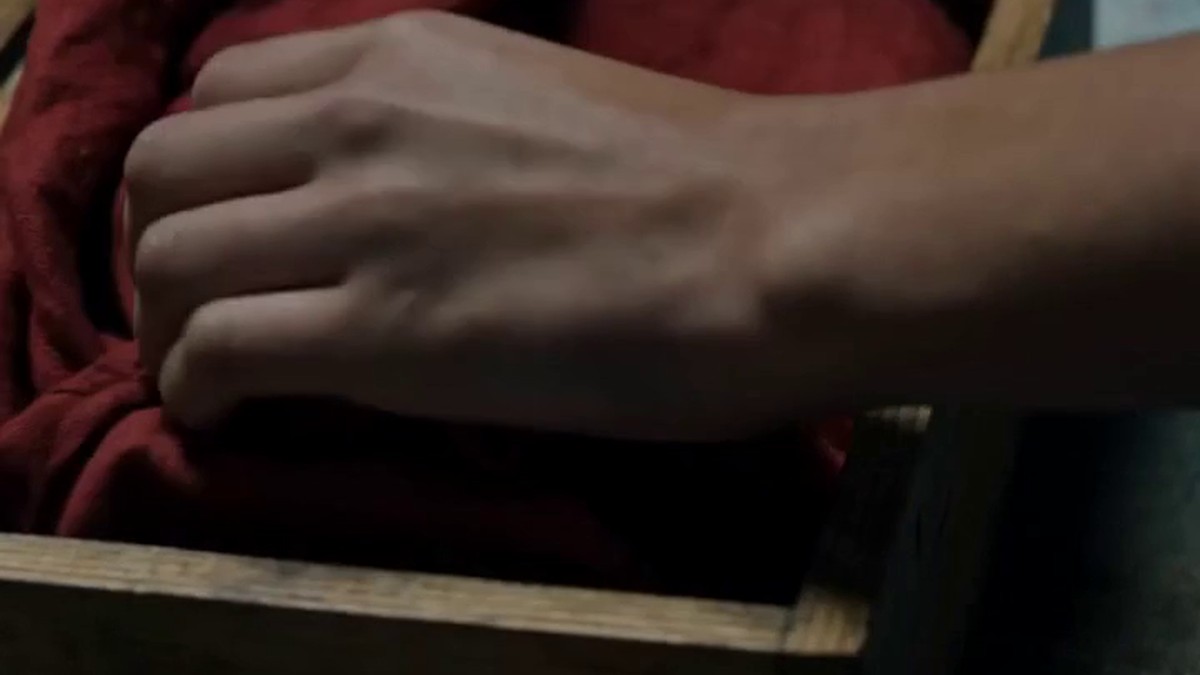
Beneath all of it, at the bottom of the box, something wrapped in a red dish towel. I saw the edge of it. Metal.
I pulled back the towel.
My knees went.
It was a car part. A brake caliper. Rust around the bolt holes, but the cylinder bore was shiny with scoring in a pattern I'd seen a thousand times on the job. I'd spent thirty years watching machines fail before their time. I knew what broken looks like.
And I knew what *made* it break.
"There are letters too, Grandma," Grace said. "Emails. Printouts from a bank account in Dad's name. He paid somebody. Six weeks before the accident."
I couldn't look at her. I was looking at the caliper.
"I found the name," she said. "He works at a body shop on Cleveland Avenue now. Somebody made them crash."
The room got very small. The oatmeal pot was still in the sink. The water bill still sat under the salt shaker. Outside, a neighbor's dog barked twice at a mail truck. Normal things. I kept listing them to myself, the way you grip a rain gutter when you're about to fall off a roof.
"Put it down," I said. My voice didn't sound like mine.
Grace was crying, or I was. The red towel lay on the floor between us.
That afternoon, I called a number I hadn't dialed in eleven years. A man answered on the third ring. I said my name, and there was a pause long enough to hold a life in, and then he said: "I wondered when you'd call."
It was the trooper who'd worked their crash scene. The state patrol had ruled it an accident — brake failure on a wet road, "improper maintenance." I'd believed it. Who wants to believe anything else?
"I've been waiting for someone to ask the right question, Mrs. Coleman," he said. "Nobody ever did. Your son-in-law's brother came to me at the funeral, drunk, saying his brother had been getting threats over money he owed. I wrote it in a supplemental report. Nobody followed up. I'm not proud of that. I'll meet you wherever you want."
We agreed on the following morning, at the house, before I went anywhere near Cleveland Avenue.
I called a lawyer too — not the one who'd handed me the folder eleven years ago, but a woman named Reyes downtown, whose firm handled wrongful death. She told me to bring everything and touch nothing else in the meantime. She also told me, flatly, not to go to that body shop alone. I told her I'd think about it. I didn't mean it.
Grace and I opened the envelope together that evening, at the kitchen table, with the six older kids asleep upstairs. Inside was a letter in my daughter's handwriting, dated two weeks before she died. She wrote that her husband had gotten into money trouble with a man he used to do side work with, a mechanic named Russell Ott, over an unpaid loan that had ballooned past what they could pay. She wrote that Russell had come to the house twice, and the second time he hadn't yelled — he'd been calm, which scared her more. She wrote that if anything ever happened to them, she wanted whoever raised her children to know she loved her father even though they hadn't spoken, and that she was sorry, and that she hoped somebody would look in the basement someday. She signed it *Mom*, like she was already writing to the kids as their mother-once-removed, already gone.
I read it twice. Grace read it three times, tracing her mother's handwriting with one finger, not touching the ink, the way you'd trace a photograph.
The trooper came the next morning and sat at my kitchen table with the caliper, the papers, and my daughter's letter spread in front of him. He took photographs of everything with his phone, wrote down the part number, and made a call right there from the kitchen. Then he looked at me and said the case would be reopened as a homicide investigation, and that I was not, under any circumstances, to go near Russell Ott myself.
I went anyway. Two days later, on a Thursday, with Grace's permission slip signed and her at school like I'd promised, I drove to the body shop on Cleveland Avenue. It was a low brick building with three bays and a faded sign. A man in a gray uniform shirt with "RUSSELL" stitched over the pocket was leaning under the hood of a Ford pickup.
I set the caliper on the counter next to the register. The scoring caught the fluorescent light.
He looked at it for a long moment before he looked at me. Something moved behind his eyes — recognition, then the particular stillness of a man doing math on how much trouble he's in.
"I don't know what that is," he said.
"You do," I said. "You installed it. On my daughter's husband's car. Six weeks before he stopped paying you, and six weeks before his brakes failed on a wet road that wasn't wet enough to kill two people going forty miles an hour."
He didn't run. I'd half expected him to. Instead he set down the wrench in his hand very carefully, like it mattered where it landed, and said, "He owed me eleven thousand dollars. I wasn't supposed to — I only meant to scare him. Make the pedal go soft, make him think he needed new brakes, make him come crawling back with the money. I didn't cut the line all the way. I swear to you I didn't cut it all the way."
"You cut it enough."
He didn't answer that. A trooper's cruiser pulled into the lot behind me — I'd told Grace's principal where I was going that morning, and the principal, thank God, had called the number the trooper had left with me. Russell Ott didn't try to leave. He stood there with his hand still resting on the wrench he'd set down, and when the trooper read him his rights, he said, "okay" in a voice so small it barely made it across the bay.
That was three weeks ago. He's out on bond now, awaiting trial, and Reyes says the civil case will take longer than the criminal one, and that no amount of money that comes out of it will feel like enough, and she's right.
Last night, all seven of the kids sat around the table while I read them their mother's letter, out loud, from the beginning. Grace sat closest to me, close enough that I could feel her shoulder against my arm the way you feel a hand you're not sure will stay. When I finished, nobody said anything for a while. Then the youngest, who barely remembers his mother's face, asked if he could keep the envelope. Not the letter — just the envelope, with her handwriting on the front.
I gave it to him. He folded it into a small square and put it in his pocket like a stone he meant to carry.
I put the caliper in a drawer in my nightstand, wrapped back in the red dish towel, and I don't know if I'll ever throw it away. Some nights I still hear the stair creak the way it did that winter. But now, when I go down to check, I turn on the light, and I look, and there's nothing there but boxes with my daughter's handwriting on them, and a workbench with a vice still bolted to the corner, waiting for someone to use it again.




Il guanto nell’armadio di Villa Caprile
L'aula del Tribunale di Verona era piena fino all'ultimo posto quel martedì di novembre. Giornalisti con i taccuini pronti, avvocati...


Chi comandava l’irrigazione
— Io faccio la grigliata con le amiche, e tu vai a bagnare le aiuole! — buttò lì Marisa, mentre...


Il bracciale di mia madre, e la restituzione che mi ha zittito
Mi chiamo Enzo Ferraris, ho quarantatré anni, faccio il geometra a Verona, e per sei anni ho avuto una nuora...


Il foglietto nel taschino del camice
Lavoro da diciassette anni come infermiera caposala in cardiologia in un ospedale di Bologna, e ho imparato una cosa: gli...


Il violino di Kalista e i soldi che Brennan non capì mai
Il violino di Flavia e i soldi che Edoardo non capì mai Il salone del Grand Palazzo Visconti, al settimo...
Alle sette e dieci Teresa annullò il bonifico che faceva a Matteo il primo di ogni mese.
Alle sette e dieci Teresa annullò il bonifico che faceva a Matteo il primo di ogni mese. Erano trecento euro....
La sciarpa arancione di Adele si impigliò nella cassetta della posta proprio mentre lei cercava di uscire dal portone
La sciarpa arancione di Adele si impigliò nella cassetta della posta proprio mentre lei cercava di uscire dal portone. Tirò...
Mia madre si infilò il telefono nella tasca del grembiule.
Mia madre si infilò il telefono nella tasca del grembiule. — Lascia stare. Quella gente è venuta da fuori. Ormai...