
EN
The Nurse Who Remembers Room 214

I've worked the postpartum floor at St. Vincent's in Springfield for nineteen years, and you'd think by now nothing surprises me. But every so often a family walks through that door and I have to step out into the hallway for a second, just to catch my breath.
That's what happened with the Okafors.
I was on the four-to-midnight shift the day Adaeze delivered — a Tuesday in March, sleet coming down outside so hard the windows in 214 rattled every time the wind picked up. Her mother, Grace, had flown in from Houston three days early, sitting in the vinyl chair by the window with a tote bag full of yarn she never touched. She kept saying she didn't want to be in the way. She was in the way constantly, and nobody minded.
I remember the smell of the room — hospital coffee gone cold on the windowsill, and underneath it that hand sanitizer smell that never really leaves you once you've worked labor and delivery. Somewhere down the hall a television was playing a rerun of Wheel of Fortune, low volume, the kind of sound that just becomes part of the walls.
Grace didn't ask to hold the baby right away. That surprised me. Most grandmothers have their arms out before I've even finished the paperwork. She waited almost forty minutes, sitting there, watching Adaeze nurse him, watching her son-in-law Marcus fumble with the hospital bassinet's wheels like they owed him money.
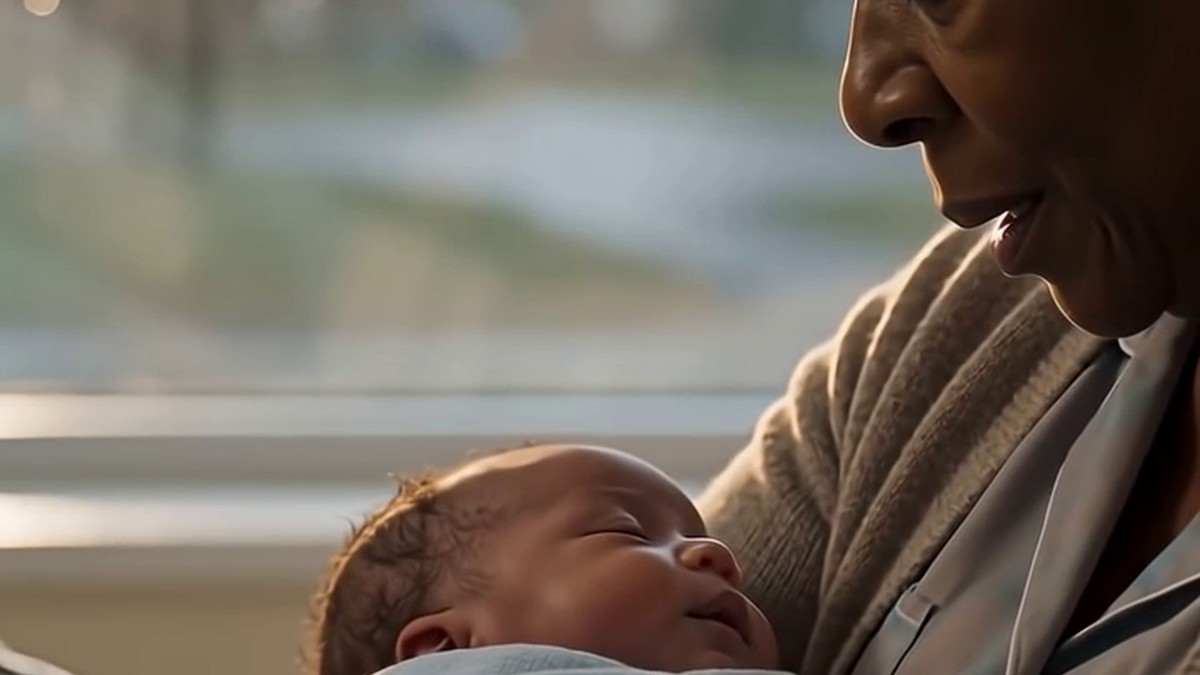
When Adaeze finally held the baby out — his name was Elias, six pounds eleven ounces — Grace stood up slow, the way people do when their knees have opinions about it. She didn't say anything clever. She just took him and walked to the window.
I had charts to update. I had a call light going off in 212. But I stood in that doorway a beat longer than my job required, because something about the way she looked down at him stopped me.
She wasn't smiling, not really. Her mouth was doing something more complicated than that. She pressed her lips to the fuzz on top of his head and just stayed there, bent over him, for what felt like a full minute. Her free hand found the little fold of blanket at his shoulder and kept adjusting it, tucking and re-tucking a corner that was already fine.
"He's got Adaeze's forehead," she said finally, mostly to the window, mostly to nobody.
Marcus laughed and said something about hoping he got his mother's temper too, not hers, and Grace swatted his arm without even looking at him — a reflex, like she'd done it a thousand times before, at a different kitchen table, in a different decade.
I had to go check on 212. When I came back twenty minutes later, Grace was still standing by that window, still holding him, and she'd started humming something low I didn't recognize — not a lullaby exactly, more like a hymn she'd forgotten most of the words to.
I've seen a lot of grandmothers in this job. Some of them are already on their phones texting the church prayer chain before the cord's even cut. Some can't wait to hand the baby back and go find the cafeteria. Grace wasn't like either. She held on to that baby like she was doing arithmetic in her head — counting something backward, thirty-some years, to a rocking chair in a house I'll never see, a baby I'll never meet who grew up to be the woman lying in that bed.
Before I clocked out that night, I stuck my head in one more time to check vitals. Grace had finally sat back down, Elias asleep against her shoulder, and she wasn't rocking him anymore. She was just still — her hand flat on his back, feeling him breathe.
Adaeze was watching her mother from the bed, half-asleep herself, and she said, quiet, "You okay, Mama?"
And Grace said, "I'm just visiting somewhere I haven't been in a long time."
I didn't ask what she meant. It wasn't my business, and besides, I had a two a.m. round to finish. But I've thought about that line more than I'd have expected to, these past few months, whenever I walk past 214 and it's some other family in there now, some other grandmother standing at that same window.
I found out later, from Adaeze during a follow-up visit, that Grace had raised her alone, no help from anybody, working double shifts at a plant outside Houston for eleven years just to keep the lights on. Adaeze told me her mother used to say she was too tired most nights to remember rocking her to sleep — that whole stretch of her daughter's babyhood was mostly just exhaustion and fluorescent lighting, gone before she could hold onto it.
Maybe that's what I saw in that hospital room. Not just a grandmother meeting a grandson. A woman getting a second pass at something she thought the years had already taken from her, standing by a rain-streaked window in Springfield, humming half a hymn to a six-pound stranger who already, somehow, belonged to her completely.




The Red Dress at Millbrook High School
I'm writing this from the father's side of things, because I became the guy people stop on Main Street to...


Донька в дощовищі, квиток на моє ім’я
Дощ у Броварах у той вечір лив так, що асфальт на Курганній парував, а неонова вивіска «Продано» на воротах маєтку...


The Locksmith Bill on the Kitchen Table
My name's Ray Kowalczyk, I'm fifty-eight, and I run a small HVAC repair shop off Route 9 outside Scranton, Pennsylvania....


The Nurse Who Remembers Room 214
I've worked the postpartum floor at St. Vincent's in Springfield for nineteen years, and you'd think by now nothing surprises...


Мій СТО у Вінниці й тиша, яка коштувала мені сорок тисяч гривень
Мене звати Тарас, мені тридцять шість, я механік з дванадцятирічним стажем, і я довго думав, чи варто взагалі про це...


The Man My Husband Called His Uncle, Though the Apartment Had Been His Home Before Anyone Else Was Born
Derek got home with his keys still in his hand a little after eleven. Behind him, in the doorway of...


Одна ложка застигла її на порозі власної спальні
Дощ у Чернівцях того листопада йшов зрідка, тоненькими нитками, і Ліда чула, як краплі стукають об жерстяний підвіконник готелю "Буковина",...


The Contract I Almost Signed
I run a small machine shop outside Scottsdale, Arizona — nothing fancy, mostly CNC milling for aerospace subcontractors. Twenty-two years...