
EN
Not Just for One Night

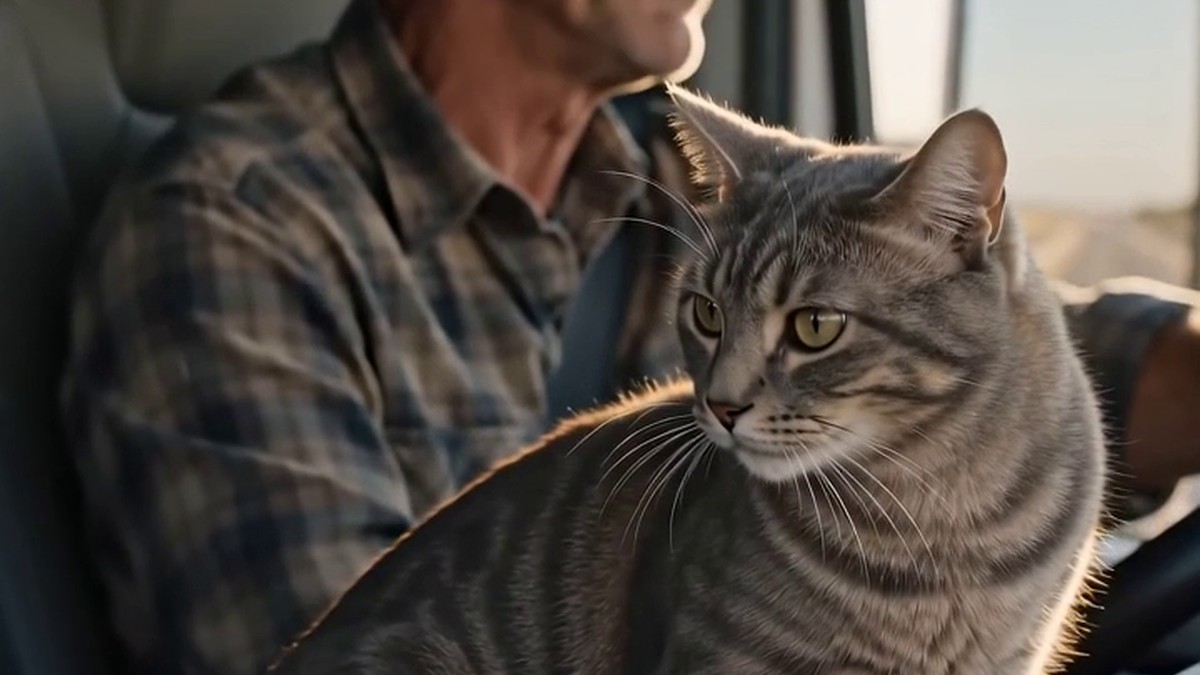
Walter Bennett had kept the same rule for fourteen years: nobody rides in the cab. Not hitchhikers, not cousins who swore it was "basically on your way," not fellow drivers looking for a lift between terminals. The cab of his rig was his, two hundred square feet of order where everything had its place and nobody asked why he didn't talk much. The rule held until a Tuesday in late October, somewhere on I-80 outside Elko, Nevada.
He'd been hauling ceramic tile toward Salt Lake City, nine hours into the shift, when the rain turned into that fine, sticky mist that makes wiper blades useless and headlights smear across the windshield like watercolor. His back had gone stiff an hour back. His coffee, poured that morning from a battered steel thermos, had gone cold and bitter, and he drank it anyway because that was the only kind of coffee he'd ever let himself want.
"Twenty more miles," he said out loud, mostly to hear a voice. "Then the rest stop."
That's when something gray shot out from under an oncoming sedan's tires. Small. Fast. Right into his lane.
"Son of a—"
He stood on the brake. The trailer screamed, the whole rig lurched, and somewhere behind him a stack of pallets broke loose with a crash that sounded like the end of something. The seatbelt caught him hard enough that his vision went dark at the edges for a second.
Then quiet. Just the wipers, ticking.
He climbed down without killing the engine. His legs felt like they belonged to someone else. He swept his flashlight across the wet grass on the shoulder, and there it was: a kitten. Gray, filthy, ribs showing even through matted fur, staring up at him with eyes the size of nickels, mewing in a voice too weak to carry.
"You're alive," Walter breathed. "Would you look at that."
The kitten tried to stand. Its legs splayed sideways. It fell on its flank and kept crying from where it lay. Rain ran down the back of Walter's collar. Cars passed, throwing up spray, and not one of them slowed.
"What am I supposed to do with you, huh?"
The kitten didn't answer.
"Fine. I'll take you to the truck stop. We'll figure it out there."
He scooped it up — it fit in one palm — and tucked it under his flannel. It didn't fight him. Just pressed against his shirt and went still. Back in the cab, he found a shoebox behind the seat, dropped an old work shirt inside, and set the kitten down.
"Sit tight. No surprises, you hear me?"
It curled into a comma shape and was asleep inside five minutes.
The Flying J off Exit 180 greeted them with sodium lights and the smell of diesel. Walter cut the engine and the silence after nine hours of road noise rang in his ears. He carried the box inside, set it near the vending machines where the heating vent blew warm air, and told himself: somebody'll take it. Place runs twenty-four hours.
He walked back to the truck. Twenty steps. Thirty. Behind him, a thin cry kept going.
He opened the driver's door. Stood there. Swore under his breath, tossed the keys back onto the seat, and walked back inside.
"Fine," he said, lifting the box. "One night. You hear me? One. Tomorrow I find you a home."
The kitten wouldn't stay in the box. It climbed his jeans, settled on his knee, and started purring — loud, rattling, like an old refrigerator kicking on. By morning it was still there, watching him with its eyes already open before his alarm went off.
"You're a piece of work," Walter told it. "Alright. One more day. Last one."
That "last day" turned into a pit stop for a carton of milk, a plastic bowl, and a roll of paper towels, just in case. The cat drank like its ears were going to fall off. Then it washed its own paw, slow and deliberate, like it had been doing this its whole life.
"Fast learner," Walter admitted.
By evening it was riding on the dashboard, watching the highway like it had opinions about every car that passed.
"Don't fall off up there," he warned. "I will not be scraping you off my windshield."
Near Winnemucca, somebody cut across three lanes without signaling.
"You see that?" Walter said, indignant. "Idiot. That's how you end up at the body shop for two weeks."
The cat meowed.
"That's what I'm saying."
He caught himself talking out loud. Not the usual mutter a man falls into on hour six of a drive — talking *to* someone. That night he took a picture: the cat had climbed onto the steering wheel and sat there looking like it knew exactly where it was going. He sent it to Diane. First text he'd started in months.
*Meet my new co-pilot.*
She took a long time typing back. Then: *You? With a cat?* A minute later: *Didn't know you had it in you to take care of something.*
Walter stared at the screen and didn't know what to say, because she was right. Twenty-two years married, and most of them he'd spent either on the road or asleep before the next run.
He called his son the next day. For no reason. The first time in longer than he wanted to count.
"Dad? Everything okay?"
"Nothing's wrong."
"You never call just to call."
"Well, I'm calling just to call." He paused. "Hey. You remember when you were nine, you asked for a cat?"
Silence on the line.
"I remember," Jacob said. "You told me we didn't need the hassle."
"I did say that." Walter cleared his throat. "I was wrong, son. Picked up a cat on I-80 a few days back. Gray, skinny little thing."
More silence. Longer this time.
"You feeling alright, Dad?"
"I'm fine. Just changed my mind. Little late, but I changed it."
"That's good," Jacob said, in a voice that sounded strange, further away than the phone line could explain. "That's real good."
"Only thing is, I don't know what to call him."
Jacob answered without a beat. "Hank."
"Why Hank?"
"Because I already had the name picked out. Way before I asked you. Walked around for a week thinking about it."
Walter sat holding the phone, looking at the cat, which had just climbed onto the dashboard tray.
"You hear that?" he said finally. "You're Hank. Turns out somebody's been waiting fourteen years for you."
December came. Hank filled out, grew a real coat where the gray rag used to be. He learned the road — leaning into the seat before a turn, bracing before a stop. Walter rigged him a bed behind the driver's seat, switched him to real cat food, and started carrying a separate water bottle just for him.
"Spoiled rotten," he grumbled. "Living better than half the people I know."
Diane started calling every night. Not "where are you," not "when's the check coming" — just to talk.
"How's it going out there?"
"Fine. Hauling coffee this week. Hank's keeping an eye on the road."
"Tell him I said hi."
Walter caught himself watching the clock, turning the ringer up louder around 8 p.m. so he wouldn't miss it.
The mountains met them the way mountains always do — without warning. Near Donner Pass, it was three degrees and sunny that morning. By six that evening, Walter was watching something he'd only seen two or three times in twenty years behind the wheel. First came snow, fat and almost festive. Then wind, and the snow stopped falling and started flying sideways. Visibility dropped to maybe thirty feet. He'd swapped to winter tires back in October, but winter tires don't help when you can't see where the road is.
"Bad news, Hank," Walter said. "We make the rest area and ride it out."
Eleven miles to go. The engine started sputtering past mile marker eight.
"Not now," Walter said to the dashboard. "Please, not now."
The rig shuddered, dragged another two hundred yards, and died. Dead in the middle of the climb, half-blocking the lane. The starter turned over. The engine wouldn't catch. Again. Again.
He checked his phone. No signal. Not one bar — happens all the time up in those passes.
"Well," he said. "Here we are."
Hank came over and pressed against his hand.
A cab stays warm only as long as the engine runs. After that, the cold moves in fast. An hour later, Walter sat wrapped in two jackets, thermal layers, and an old moving blanket he kept behind the seat. Snow caked the windshield until the cab turned into a white box. He ran the hazards while the battery still had charge, then shut them off to save power.
What he had left: a thermos with the dregs of coffee, two candy bars, and half a sleeve of crackers.
"We'll hold out," he told Hank. "Road crew comes through here. Not today, tomorrow."
Nobody came. Not that evening, not that night — the highway had been closed further down, something he'd only learn later. By midnight the cold had worked into his teeth. Walter did jumping jacks right there in the cab, stamped his feet, rubbed his fingers. Sat. Stood again. Hank never left his side, burrowed under the jacket against his chest, shaking.
"Cold, buddy?"
The cat said nothing.
Walter looked at the white sheet where the windshield used to be and understood something very simple. If he'd been alone, he'd have already lain down. Just lain down, pulled the blanket over his head, and gone to sleep. And that would've been the last thing he ever did, because in that kind of cold, sleep kills you.
But under his jacket, something gray and warm and alive was shaking. Shaking because it believed this big, quiet man knew what he was doing.
"Can't sleep," Walter said out loud. "You hear me? Can't. You'd freeze."
He pulled a sleeping bag out from behind the seat, tore out the foam padding, built something like a nest, and covered it with the blanket. Climbed in with the cat. It helped, a little. All night he counted out loud — to a thousand, then back down. He told Hank about fishing with his father on the Snake River. About Jacob at four years old, asleep on his shoulder at a Greyhound station. About the first loaf of bread Diane ever baked, burned black three times in a row, and how he'd eaten all three and told her they were good. He talked the whole night through, because as long as you're talking, you're not asleep.
The second day was worse. The coffee ran out. He melted snow in a bottle tucked against his chest, sip by sip. He broke a candy bar in half and set a piece in front of Hank. The cat sniffed it and turned away.
"Not for you, I know," Walter said. "It's all I've got."
Around noon the wind eased enough that he climbed out to check the engine. Five minutes outside, and his hands wouldn't bend when he climbed back in. The second night bled into one long gray smear. Hank lay on his chest, breathing fast and shallow. By dawn he'd barely moved at all.
"Don't you do this," Walter whispered, his voice cracking. "Stay with me. I can't do this without you, you hear? I already tried. Fourteen years of without. Doesn't work."
Then, through the wind, he heard an engine — low, heavy, nothing like the white silence around him. He threw himself off the seat, shouldered the door open against a wall of packed snow, and fell out onto the road. Below, around the bend, an orange CalTrans plow was grinding uphill. He waved both arms and shouted something he couldn't make out himself.
The plow stopped. Two men climbed down in bright orange jackets.
"You alive in there?" the older one called.
"Alive," Walter said.
"Just you?"
"Me and my cat."
The men traded a look. Walter knew exactly what it meant: two days stuck in a blizzard, now the man's seeing cats.
"Let's see this cat," the older one said carefully.
Walter carried Hank out in both hands. The cat lay still, barely a flutter at his ribs.
"Well, look at that," the younger one said. "There really is a cat. And he's breathing."
"Course he's breathing," Walter snapped. "I kept him warm the whole time."
At the ranger station in Truckee, they poured hot drinks into Walter and wouldn't let him leave the heated room for an hour. Meanwhile, Hank was being examined by a vet from the local animal clinic — a young woman with short, graying hair.
"Dehydration, exhaustion," she said. "But his heart's strong. A week of food and warmth and he'll be running circles."
"A week," Walter repeated. "I can do a week."
He paid the bill without asking the total and bought two months' worth of food and vitamins on top of it.
Diane met them at the door. She stood there holding him for a long time without saying anything, then pulled back, wiped her cheek with the back of her hand, and took Hank out of his arms.
"So this is your co-pilot?"
"Mine," Walter nodded. "Best one I've had."
Diane sat on the couch with the cat, and Hank settled onto her lap like he'd lived there his whole life.
"You've changed," she said, not looking up. "You know when I noticed? When you called me just to call, for the first time in ten years."
Walter stood in the middle of his own kitchen and didn't know what to do with his hands.
"That wasn't me. He taught me that."
"Him," she agreed. Then, suddenly: "What if we got a dog too? From the shelter. We've got the room."
Walter looked at the cat. "Don't you go getting replaced by a dog, partner."
Hank meowed once, short and businesslike, like he was shaking on it.
"Then we're getting one," Walter told his wife. And in their house, for the first time in years, they both laughed at once, out loud, the way they used to.
Three months passed. Hank settled fully into his role as co-pilot — his own bed in the cab now, two bowls, a toy mouse on a string he dragged around and hid under the seat. At rest stops, other drivers come up to ask.
"That the one?"
"That's him."
"Let's see him."
And Walter pulls the cat out and tells the story — probably the hundredth time now — about the wet shoulder and the gray blur that shot under his tires.
"Now that's a co-pilot," the drivers say. "Not like some people."
"Best one going," Walter agrees. "Doesn't complain, doesn't ask for a bathroom break every thirty minutes."
Jacob came home for Christmas. First time in two years. He spent half the evening on the floor with the cat, barely talking, just running his finger through the carpet fibers. When he got up to leave, he hugged his father — stiff, sideways, the way grown sons do.
"Dad. Take care of yourself too. Not just him."
They drive as a pair now. Diane calls every evening at eight. Jacob texts every week, asking for pictures. Walter sends them: Hank on the wheel, Hank asleep on the dash, Hank watching snow fall over the peaks through the glass.
Outside the window, snow is falling — the same kind that fell that night on the pass. But Walter doesn't flinch at it anymore. He's not alone up there now.

