
EN
The Nurse and Two Rosaries in the Safe

**The Nurse and Two Rosaries in the Safe**
I heard this from a woman who ran a care home in Tulsa for eleven years — small place, eighteen beds, the smell of chicken and rice on the first floor, and one staircase where the click of heels carried all the way to the chapel.
I won't give this resident's real name. Let's call her Sister Marianne.
I showed up on a Wednesday, because a night-nurse position had opened and I was looking for something closer to home. The director — Ms. Wilhelmina, a small woman with keys clipped to her belt like a string of beads — walked me through the building. It smelled like floor wax and a little bit of mildew. One votive candle burned in the chapel, under a vase of plastic lilies.
That's when I saw Sister Marianne.
She sat on a bench by the window with a baby on her lap. Maybe eight months old. A second, slightly older child crawled across the floor and tugged at the fringe of her habit. Her face was as calm as still water, and she watched the infant like nothing else in the world existed.
"That's Sister Marianne," Ms. Wilhelmina said, lowering her voice so I felt her breath on my ear. "Third one in three years."
"Third what?" I didn't follow.
"Baby. She's expecting again."
I froze with my bag still in hand. This was assisted living for retired priests and nuns. Men were only allowed into the chapel on Sundays, and only with the mother superior's permission. And this young nun — maybe twenty-eight — sat in front of me with two kids and a third on the way.
"So nobody knows how this keeps happening?" I asked.
Ms. Wilhelmina just shook her head and adjusted her keyring.
For the first week, I watched Sister Marianne from a distance. She fed them, changed them, sang to them in a thin voice that echoed off the walls like it was bouncing up from a well. When the mother superior — Mother Bogdana — walked into the room, Marianne would stand, and the children would duck behind her habit. The older boy, Anthony, didn't say a word around me for the first three days. He just watched from under his bangs, chewing on his sweater sleeve.
Mother Bogdana didn't strike me as a woman who tolerated much of anything calmly. Narrow face, dark eyebrows, and she wound her rosary around her hand like she meant to strangle it. I once heard her on the phone with a priest from the parish:
"Look into this properly, because I can't keep being responsible for what people are saying."
But nobody looked into anything. What was there to look into? Mother Bogdana bolted the doors herself every night. The windows in the rooms had bars on the outside, because the building used to be a hospital. And Marianne never left the garden, not even for a minute.
I didn't get it. And maybe that's why I started staying half an hour past my night shift, pretending to drink tea in the break room.
One night I heard Marianne talking to the infant.
No — not to the baby. To someone. But the voice that answered didn't belong to a child.
It was early December, three in the morning. I was walking the hallway quietly because I'd run out of coffee in my thermos. That's when a low man's voice came from Marianne's room.
"Just this one more time," it said. "I promise. Then it's done."
I stopped walking. My heart was pounding, and my hand drifted toward the door handle on its own. The door was cracked open the width of a hand. I looked in.
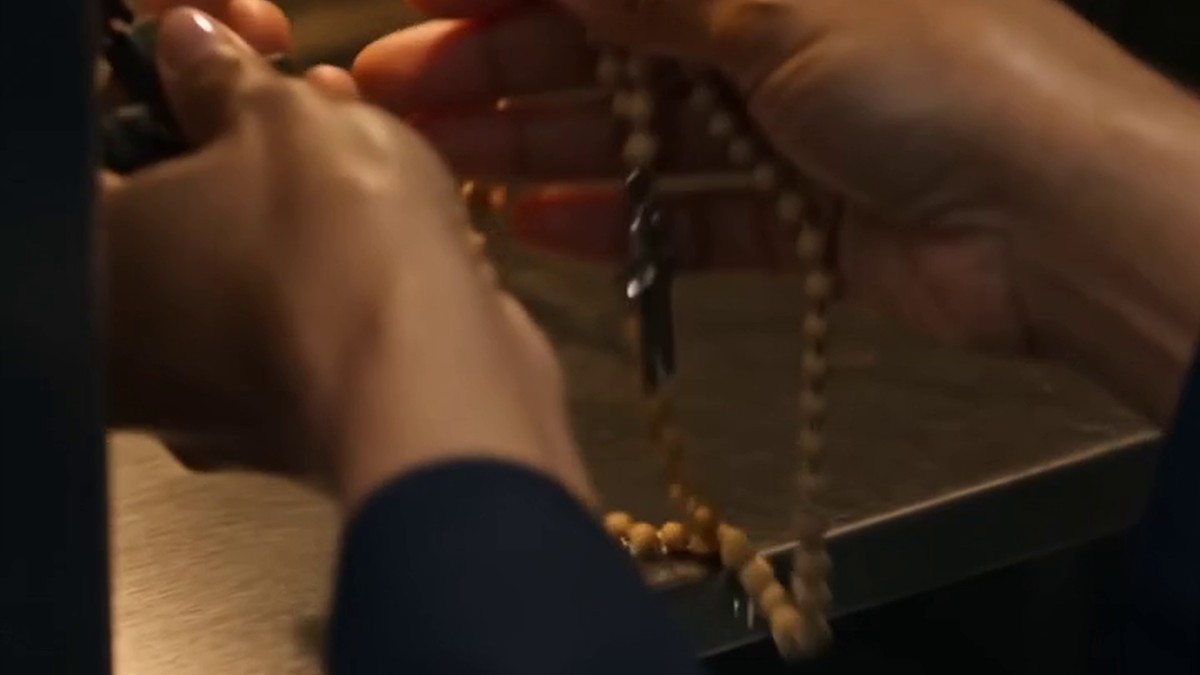
Marianne knelt by the bed. In front of her sat an open safe — a small iron box, the kind meant for documents. There was no money inside. There were two rosaries. One black, tangled, with a broken crucifix. The other made of pale wood, with a medal that caught the light of the nightlight.
And that second rosary — Marianne held it to her lips and said something I couldn't make out. The voice I'd heard a moment before had gone silent.
I stepped back. A floorboard creaked.
Marianne didn't turn around. She just locked the safe, tucked the key into the neckline of her habit, and went back to bed like nothing had happened.
The next day I asked Ms. Wilhelmina for a minute.
"Is there any man at all in this building?" I asked, flat out.
"There is. Father Harold comes Tuesdays and Fridays. Hears confession." Ms. Wilhelmina tapped her pen against the desk. "But he's eighty-one and can barely see."
"What about that safe in Marianne's room? Who gave it to her?"
Ms. Wilhelmina looked at me a beat longer than she needed to.
"That safe's been there twenty years. It belonged to Sister Veronica. The one who died before you got here."
"What happened to her?"
"Cancer. Took her in seven months. And you know what she kept in that safe?"
I shook my head.
"Documents. Birth certificates. Three of them."
I felt the cold settle into my fingers.
That evening, after dinner, Mother Bogdana called me into her office. Papers lay on the desk, and on top of them — a photo of a young nun holding a baby. Written in pencil on the back: "Veronica, 1998."
"You're asking about things that aren't your business," she began. "But since you've already seen the safe, you might as well know how it really was."
And she told me.
Twenty years ago, Sister Veronica had also started "getting pregnant." No man in sight. No explanation. Two births, then a third. Same thing every time: dizziness, nausea, a growing belly. And every time, that same calm face, like the baby had simply fallen from the sky with the rain. When she had the third one, she died in childbirth. The baby survived.
"That baby was Marianne," Mother Bogdana said.
I couldn't get a breath in.
"So it's… hereditary?" I asked, because nothing better came to mind.
"Sister Veronica got pregnant because she had a husband." Mother Bogdana said the word like it burned her mouth. "Not a member of the clergy. An ordinary man, an electrician from Sand Springs. They got married in secret, at the courthouse. He'd leave her money in that safe, and she'd give birth and hand the children off to an aunt in Sand Springs. But the third pregnancy was too much for her body. She died, and Marianne ended up in an orphanage, because nobody wanted to admit whose baby she was."
"Then where do all these 'miracle pregnancies' of Marianne's come from?"
Mother Bogdana stood and walked to the window. Outside, the first snow of the season was falling.
"Because Marianne isn't pregnant, ma'am. She never has been."
I went still.
"These children?" I asked.
"They're not her biological children. They're her brother's. The one Veronica gave birth to first and handed over to the aunt. Anthony, the child you've seen, and that infant — they're his kids. He was in an accident, he's disabled now. No wife. Marianne agreed to raise them so they wouldn't end up in foster care. Someone brings them to her at night, through a gate in the back fence that only two people know about."
"And the pregnancy?"
"Swelling, nausea, dizziness. Diabetes, kidneys, thyroid — doesn't matter what. What matters is what people see. And people see a nun with a belly, and they don't ask where the baby came from."
I went back to my room and sat on the bed a long time, watching the window. Outside, snow was covering the footprints in the yard. Nobody came that night.
In the morning I saw that the safe in Marianne's room stood open. It was empty. At the bottom lay only the key and a note folded into quarters. I didn't read it. That was the last day of my trial shift.
That evening I turned in my notice before I'd even signed the contract. Ms. Wilhelmina slid a pen across the desk to me without asking why.
"Probably for the best," was all she said. "Not everyone's built to carry other people's secrets."
I walked out to the bus stop. The Route 17 bus pulled up right on time at 8:14 p.m. A light was on in the upstairs window — Marianne's room. I watched her lift the baby onto her shoulder and stand there without moving, staring into the dark.
I didn't wave. She didn't turn around.




Він забрав квартиру, тепер хоче забрати мій спокій — розказує Марко
Мене звати Марко Гнатюк, мені сорок два, і я працюю технічним директором у логістичній компанії у Вінниці. Розказую цю історію...


Ключ, який не підійшов до батькового замка
Того ранку, коли ховали батька, Марина Гончар виявила, що замок на дверях гаража на Троєщині вже не відкривається її звичним...


Розлучення на межі Карпат: тепер батько Мари вирішує, скільки коштує моя тиша
Я не пам'ятаю точно, коли зрозумів, що більше не витримаю. Може, тоді, коли Ірина вдруге лежала в лікарні, а моя...


The Cookie Tin on Maple Street
# The Cookie Tin on Maple Street Eleanor is seventy-two years old and has one rule she never breaks: on...


The Long Deployment
Four years of combat pay, almost every dollar of it, went straight into a joint account back in Millbrook, Ohio....


The Nurse and Two Rosaries in the Safe
**The Nurse and Two Rosaries in the Safe** I heard this from a woman who ran a care home in...


The Notebook That Went to Riverside Drive
I handed my daughter the holidays after thirty-eight years, and I did it without a single ounce of resentment. I...


Widow Denied Shelter by Her Son Learns Her $47M Trust Has a Trap Clause for Him
The rain had been coming down since noon, and by the time Diane Holloway's cab pulled up outside her son's...