
EN
The Scar That Exposed Sixteen Years of Lies

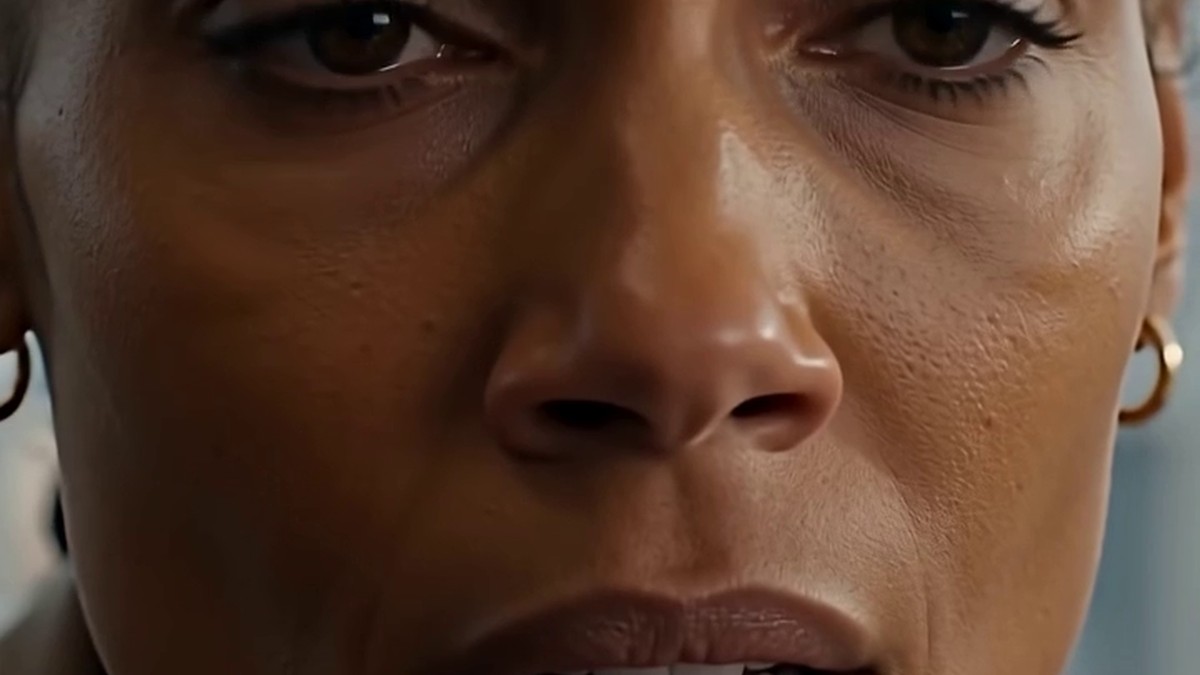
**The Scar That Exposed Sixteen Years of Lies**
We were supposed to stand under the chuppah at seven that evening, at the Marriott Harbor Beach in Fort Lauderdale, with a view of the water already turning orange with sunset. I'm Daniel Herzog, thirty-seven, a software engineer, and what was supposed to happen that night changed my life completely.
Three months before the wedding, I'd been set up with a woman named Olivia. Quiet, well-educated, spoke with a soft accent I couldn't quite place, and every single time we met, part of her face was covered. At first it was a thin scarf she said she wore "for allergies." Later it became a thick, reddish bandage wrapped around her left cheek. Her father, Mr. Arthur Kane, who owned a chain of barbershops across Broward County, always gave me the same answer when I pressed: "Once you're married, you'll understand everything." Olivia never argued with him. That's what bothered me most — she wasn't afraid to show her face. She was afraid to disobey her father.
I tried to convince myself there was a reasonable explanation. Maybe an old burn. Maybe a surgical scar. I didn't want to push. But on the morning of the wedding, I woke up and decided — I wasn't standing under that chuppah without seeing the face of the woman I was about to marry. Not even once.
About sixty people stood in the hall. My father, Raymond, stood a few steps behind me, unusually withdrawn all day, checking his watch for no reason every few minutes. When Arthur walked in leading Olivia by the arm, the conversations in the room dropped off one by one. Olivia wore a gorgeous white dress, but her entire face was wrapped in dark red fabric. Arthur brought her straight to me, looked me in the eye, and said, "Like you asked — I brought her."
I gave a small smile, trying not to make the moment more awkward than it already was. "Olivia, ready?" She barely nodded. I stepped closer, my hand moving toward her face. Arthur stiffened immediately. "Daniel—" "I'm not taking it all off. I just want to see." Olivia didn't move. I took that as permission. With my fingers, I gently lifted a small corner of the fabric from her left cheek.
And I saw the mark.
A reddish-brown mark shaped like a broken crescent, with a small round dot beside it. Right at the cheekbone. I'd seen that mark once before, years ago, in a photograph I kept in my desk drawer as a teenager.
My heart started pounding. I looked at Olivia for a few more seconds, then turned to my father. "Dad." He looked at me. "What?" "I know her." "Who?" I pointed toward the bride. "Her."
My father took a step forward. "Daniel, who is she?" I couldn't answer right away, because the name circling in my head felt impossible. This woman should have been at least fifty by now. And sixteen years ago, she vanished. My father told us she was never coming back.
I looked at the mark again. There was no mistake. "Her name isn't Olivia," I said under my breath. Arthur grabbed her hand immediately. "That's enough." I looked at him. "Her name is Rachel." My father froze where he stood. The look on his face told me everything — he knew that name.
Olivia whispered, "Rachel?" She said it like she'd never heard it before in her life. My father dropped heavily into the nearest chair. "That's impossible." I walked over to him. "You know her?" He was quiet for a long time. Then, in a voice barely above a breath, he said, "She was my wife."
Nobody in the room moved.
Sixteen years ago, when I was twenty and serving in the Army, my father remarried. Her name was Rachel Alden, almost twenty years younger than him, an English teacher at a high school in Pompano Beach. At first, I didn't accept her. But Rachel never tried to replace my mother. She was simply kind. When I shipped out for training, she made me sandwiches with sharp cheddar and olives, packed them in a plastic bag with a little note tucked inside. When I failed my entrance exam for the engineering program, she was the one who told me, "One failure doesn't define who you are." And I remembered that strange mark on her cheek clearly.
A year after the wedding, Rachel disappeared. My father told me she'd left him and run off with another man. He even showed me divorce papers. For years, I believed him. And now Rachel stood in front of me in a wedding dress, with no idea that Rachel was even her real name.
Arthur tried to pull her aside. I stood in his way. "What did you do to her?" "Nothing." "Then why doesn't she remember her own name?" Olivia started to tremble. "Dad… what's going on?" Arthur's eyes filled. For the first time, his hard expression cracked. "You're my daughter," he said. "I only wanted to keep you away from them."
It turned out Rachel's marriage to my father had been far worse than I ever knew. Rachel had decided to leave him. She was heading back to her father's house in Deerfield Beach. But on the way there, she was in a serious car accident on I-95, near Pompano. She survived, but was left with severe amnesia — near-total memory loss of the last two years of her life.
And Arthur made a decision that reshaped the rest of her life. He used her condition to build her an entirely new identity. A new driver's license under the name Olivia Kane, a new address, a fabricated past. He told her there were dangerous people from her old life who might come looking for her. "Why did you cover her face?" I asked. Arthur looked at my father for a long moment. "Because of that mark." He pointed at her cheek. "I was afraid someone would recognize her." My father lowered his head.
But the biggest shock was still coming. I looked at Arthur. "So how did she end up engaged to me?" Arthur looked at me. "Your last name is Herzog." I'd used my mother's maiden name for most of my adult life — I was born Daniel Kane, but after my parents' divorce, I took my mother's name. Arthur had never known I was Raymond Kane's son. A heavy silence fell over the hall. The wedding, of course, never happened that evening.
In the weeks that followed, Rachel began working with a neurologist and a speech-language therapist at Broward Health to piece together fragments of memory. Slowly, pieces came back to her. She remembered a house. A street with a big oak tree by the front walk. A kitchen with checkered tile. My father. And eventually, she remembered me too — the twenty-year-old I used to be.
One day she looked at me and suddenly said, "You always put two sugars in your coffee." I went still. Nobody had told her about that habit in sixteen years.
It happened on a Thursday, at a small coffee shop on Las Olas Boulevard in Fort Lauderdale, a month and a half after the wedding that never was. We sat with iced mint tea sweating between her hands, a neighbor's dog tied up outside barking at every passerby. Rachel pulled a blue folder from her bag, already open, with papers she'd picked up from the county clerk's office the week before: a formal petition for a legal name change — from "Olivia Kane" back to "Rachel Alden" — and alongside it, a civil claim she'd filed against Arthur, not for any criminal wrongdoing, but to force him to hand over her original documents, which he'd refused to release. She'd paid an attorney four thousand dollars to open the case and get a court order compelling him to turn over her original identification and the old bank passbook still in her name, kept locked away by him for all those years.
She didn't yell at her father, didn't ask him for an apology, and didn't wait for the moment he might finally understand. She simply signed the last form, slid the folder into a manila envelope, and asked the waitress for another glass of water.
Arthur showed up at her apartment two days later, standing in the doorway with his car keys in hand, not knowing what to say. The door was fitted with a new lock she'd installed herself, with help from a locksmith off Sunrise Boulevard. He knocked twice. She opened the door only a crack, holding the manila envelope with the court order in her hand, and told him, "My documents, Dad. Leave the rest outside." Then she closed the door.
That same day, she took the red bandage off her cheek for good, standing in front of the hallway mirror in her apartment, alone, with no witnesses and no cameras. "Nobody gets to decide what I have to hide anymore," she said out loud to herself, and that was the only sound in the apartment besides a dripping faucet in the kitchen.
I lost a woman I thought was going to be my wife. But a woman our family believed was gone forever came back into our lives — not as Olivia, but as herself.




Ворота Тараса
Мене звати Ольга Іванівна, і зятя мого звали Тарас. Ось хай хтось скаже, що я упереджена — так, упереджена, бо...


Кава на двох, розмова на одну
Мене звати Соломія, мені сімдесят два, і цю історію я розповідаю з боку Карменти — так, так, мене всі так...


The Scar That Exposed Sixteen Years of Lies
**The Scar That Exposed Sixteen Years of Lies** We were supposed to stand under the chuppah at seven that evening,...


The Bridge on Maple Street
Ten-year-old Callie Hensworth had a name she refused to use, and a woman she refused to call by it either....


Kittens Left Behind at Fort Worth Station
Grace Whitfield had exactly six minutes before the 7:40 to Chicago pulled out, and her boyfriend Marcus was already checking...


The Deed That Didn’t Need His Signature
# The Deed That Didn't Need His Signature The day Marisol bought the house, San Antonio was in the middle...


Пес на прив’язі за метром двору
Мене звати Оксана, мені сорок три, і сімнадцять років я працюю адміністраторкою в приймальні притулку для тварин на околиці Житомира...


Заборгованість майстерні Ковальчука
Мене звати Тарас Гринюк, мені сорок два, і я одинадцять років керую автосервісом на Замарстинівській у Львові. Той сервіс мені...